


More than 100 employers signed class settlements over their retirement plans during the past four years, with most deals under $2 million—a signal companies are seeking quick and cheap exits from costly litigation.
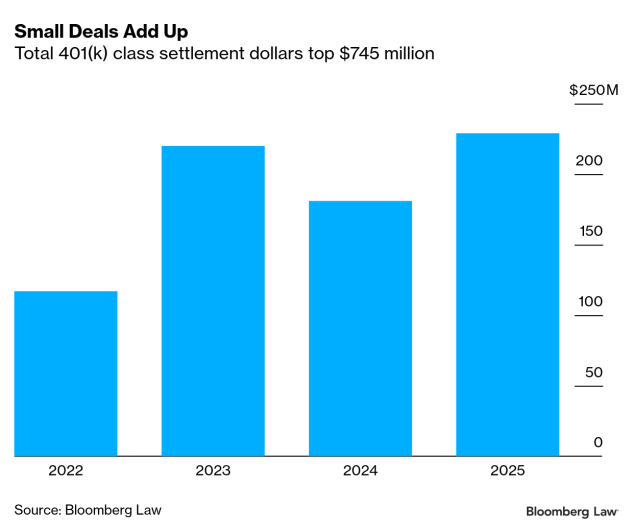
Lawsuits challenging how employers manage their defined contribution retirement plans drove more than $745 million in settlements from 2022 to 2025, a Bloomberg Law analysis found. Just a handful of major companies agreed to pay north of $60 million to resolve 401(k) disputes, but more than half the settlements announced during this period were below $2 million and the median amount for every year was $3 million or less. About 80% are worth $5 million or less.
Hundreds of employers have found themselves in the crosshairs of class litigation under the Employee Retirement Income Security Act, with a variety of plan attributes challenged. Attorneys say the breadth and scope of this litigation may act as an incentive to settle quickly and cheaply.
“Some employers feel like even if they’re doing all the right things, they can still get sued for violating a fiduciary duty related to 401(k) fees or forfeitures or their investment lineup,” said Heather Mehta, a partner with UB Greensfelder LLP in St. Louis, Mo. “Perhaps if you’re an employer who thinks they’ve done everything properly, you may just want to settle as quickly as you can and move on with your life.”
Wide Spectrum
Bloomberg Law analyzed about 140 class settlements announced in lawsuits over 401(k)-style retirement plans since 2022. The average deal struck during this period was about $5.3 million, with the median deal worth about $1.9 million. More than three dozen agreements were for less than $1 million—an amount that might be found in the retirement account of a single high earner.

The largest settlements during this period resolved allegations against massive employers.
In November,
On the other end of the spectrum are a larger number of more modest deals, including agreements negotiated by North Carolina retailer Shoe Show Inc., Nashville-based hospital system Ardent Health, Boston College trustees, and container shipping company Maersk Inc.—each valued at less than $500,000.
Downward Trend
Class actions involving large 401(k) plans began in earnest in 2006 and exploded in number in 2020. These cases traditionally focused on administrative expenses and the fees charged by specific investment options.
Some early cases led to multimillion dollar settlements with major companies, including
Many large employers worked to improve their 401(k) fee levels in the years since the litigation push began, said Carl Engstrom, a partner with Engstrom Lee LLC in Minneapolis. Over time, cases began focusing on other things, like fiduciary “blind spots” that haven’t received as much scrutiny or smaller plans that “perhaps weren’t as attuned to the litigation,” he said.
There also have been new plaintiff-side law firms wading into ERISA litigation, with some more focused on settling and less willing to take cases to trial, Engstrom said.
“The new counsel that has moved into this space seems to have taken a slash-and-burn philosophy where they’re taking cheap settlements quickly,” said Christopher Rillo, a Baker Botts LLP partner in San Francisco and co-chair of the firm’s ERISA litigation practice.
“Insurance carriers and plan sponsors have adopted an attitude where they don’t want to get involved in protracted litigation, especially if a motion to dismiss has been denied,” he said. “They settle these cases fairly quickly and fairly cheaply, and settlements under a million dollars—which once were unusual—are now routine.”
‘Whac-A-Mole’
Workers continue to sue over retirement plan fees, but more recent cases also challenge investment performance, stable value funds, and how companies handle the 401(k) contributions forfeited by departing employees—a litigation landscape Rillo likened to a “Whac-A-Mole” game.
The biggest legal theory to emerge over the past four years centers on 401(k) forfeitures, with more than 80 lawsuits challenging how employers handle this money. Most early decisions have favored the defendant employers, and only a handful of cases have settled:
Nothing suggests litigation targeting 401(k)-style retirement plans will stop anytime soon, said UB Greensfelder’s Mehta.
“I think plaintiffs’ attorneys are willing to explore theories to see if they stick,” Mehta said. Defendants have had a “pretty high success rate” in getting forfeiture suits dismissed, but that hasn’t stopped new suits from coming, she said.
SCOTUS Green Light
Employers hoping the US Supreme Court might rein in this litigation have so far been disappointed.
The justices issued three major ERISA decisions over the past six years, confronting plans sponsored by Intel Corp., Northwestern University, and Cornell University. Each time, the court resisted the opportunity to meaningfully tamp down on the ability to bring viable ERISA claims, Engstrom said.
The Supreme Court seems inclined to decide these cases on the “narrowest basis possible,” which can lead to a lack of clarity that drives litigation, Mehta said.
“I think both sides have hoped the Supreme Court would give them some guidance on these issues and say whether they saw this litigation as frivolous or full of merit, but so far they’re just not stepping on that landmine,” she said.
To contact the reporter on this story:
To contact the editors responsible for this story:
Learn more about Bloomberg Law or Log In to keep reading:
See Breaking News in Context
Bloomberg Law provides trusted coverage of current events enhanced with legal analysis.
Already a subscriber?
Log in to keep reading or access research tools and resources.