


Legislative and ballot fights over higher minimum wages will span a mix of red and blue states across the country in 2024, as worker advocates seek to emulate and expand on victories to boost pay for hourly workers.
The push to mandate a $15 minimum continues in states that haven’t reached that level, including ballot proposals that could go before Ohio and Oklahoma voters next November, plus dueling court fights in Michigan over a previous 2018 ballot initiative and a new one proposed for 2024.
But in deeper blue states that have already enacted a $15 minimum, new proposals and automatic inflation-based increases are carrying the wage floors higher, as with a California ballot measure that would move the state to an $18 minimum by 2026 if voters approve it. Hawaii’s state legislature last year became the first to enact an $18 minimum wage, set to phase in gradually by 2028.
California also added a new wrinkle to the issue this year, enacting industry-specific hourly minimums of $20 for fast-food workers and $25 for workers in health-care facilities, legislative deals that were seen as wins for the Service Employees International Union.
“It’s a new tactic from labor,” to push for legislation mandating industry-specific wage increases, said Tim Goodrich, vice president of state government relations at the National Federation of Independent Business.
“We are very concerned that is going to spread to other blue states that are labor friendly,” Goodrich added, noting that Maine and Massachusetts lawmakers have introduced bills proposing health-care-specific minimum wages.
State and local governments have dominated the policy action around minimum wage for at least the past decade, as the federal minimum has remained at $7.25 since 2009. Minimum-wage workers are scheduled to get greater hourly pay in more than 20 states and roughly 40 cities and counties in 2024.
Sen.
The steady stream of state and local wage increases is challenging for employers to manage, especially for small businesses that might still be struggling with staffing shortages and recently high inflation, Goodrich said.
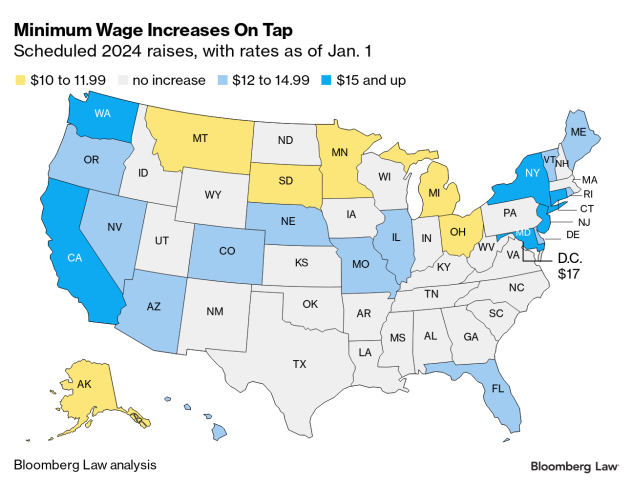
To $15 And Beyond
But progressive policy groups such as the National Employment Law Project contend that the wage increases haven’t been sufficient for workers to keep up with inflation. That includes in New York, where this year’s legislation to raise the wage floor to $17 downstate and $16 upstate by 2026 has drawn criticism for not going far enough.
Those $16 and $17 floors “may be sufficient in very low cost of living areas, but certainly not in New York,” said Yannet Lathrop, NELP senior researcher and policy analyst. The group is urging state lawmakers to revisit the wage law in 2024, and particularly to repeal the “off ramp” provision that suspends annual increases if unemployment rates increase.
A coalition of New York unions and worker groups pushed the legislature in 2023 to raise the state’s wage floor to $21.25, an attempt to account for a few years of no increases despite unusually high inflation. Lawmakers and Gov.
The inflation rates in 2021 and 2022 helped push the wage goals for the labor movement beyond the “Fight for $15” that took hold roughly a decade ago.
“There’s no fight for X amount now,” Lathrop said. “There’s no serious campaign for anything lower than 15,” but in several states worker advocates are pushing for higher minimums.
Under existing laws, at least six states plus Washington, D.C., are scheduled to mandate $15 or higher statewide in 2024: California, Connecticut, Maryland, New Jersey, New York, and Washington state. Oregon could join that list, depending on the amount of its inflation-based annual increase on July 1. More than 20 local governments already require minimum wages higher than $17 per hour, including Denver, Seattle, and 17 California cities.
In states where Republican-majority legislatures have largely opposed minimum wage increases, voters have supported raising wages via ballot measures. Florida and Nebraska, for example, are moving toward $15 minimums by 2026 based on voter-approved ballot initiatives.
With that history in mind, fighting the ballot measures in Ohio and Oklahoma will be high priorities for NFIB, Goodrich said.
“If they can get it passed in Nebraska and areas of the country where you wouldn’t expect to see it in the legislature, then Oklahoma is also an area of concern,” he said.
Virginia Democrats, after winning control of both the state House and Senate in November’s elections, also are preparing to renew efforts for a $15 minimum wage, although they don’t have the two-thirds majorities needed to override a likely veto from Republican Gov.
To contact the reporter on this story:
To contact the editors responsible for this story:
Learn more about Bloomberg Law or Log In to keep reading:
See Breaking News in Context
Bloomberg Law provides trusted coverage of current events enhanced with legal analysis.
Already a subscriber?
Log in to keep reading or access research tools and resources.